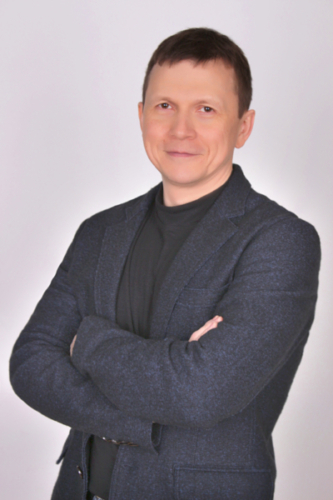
Sergey Gafurov – Architect ByeleX
‘Working together with good people while solving complex problems is fun’
“Getting into software development came somewhat naturally to me. I think this is often where you end up if you genuinely enjoy creating computer programs and systems”
It all started in the late 1980s, when I was in middle school
‘I began by learning BASIC on a Yamaha MSX2 — a Japanese computer that was quite rare in schools in the USSR at that time. I later entered a school with specialized classes in physics and mathematics, and from there the next step was programming contests.’
Competitive programming turned out to be extremely addictive. Older friends and teachers taught Sergey mathematics and algorithms, and he eventually won several contests. As a result, Sergey was admitted to the Faculty of Applied Mathematics and Computer Science at Belarusian State University without entrance exams.
‘University gives you a profession. Mine, at least officially, is “mathematician and systems programmer”. In this way, my fascination with mathematics and problem-solving naturally led me into the software development industry.’
In 2001, Sergey was recruited by one of his professors
This professor was involved in building an expert system for Byelex. His very first task? Implementing a new version of that system in Java, making it accessible via the internet.
ByeleX
After many years of collaboration, Sergey no longer thinks in terms of locations. ‘There is no ByeleX Netherlands team, and no ByeleX Eastern Europe team. It’s just one big team working from two offices.’ That mindset shows in how projects are approached: shared responsibility, open discussion and a strong sense of collective ownership.
Business trips to the Netherlands left their mark — though not necessarily in the expected ways. ‘Yes, Amsterdam came with a few “shocking moments,”’ but Sergey quickly dismisses that as uninteresting. What stayed with him instead are simpler impressions: the view from the plane while landing, the charm of smaller cities, and the friendliness of people. ‘It’s just a nice place to visit.’
Projects to be Proud of
Over the years Sergey worked on many projects he is proud of. One example is KCStreet for ArboNed. First committed in June 2007, it has grown into a large, complex software system that has evolved technologically — from Java 6, Java EE and EJB 2.1 to Java 17, Spring Boot and Docker. It represents the combined effort of many skilled engineers and has served the customer well for almost 18 years. It is the kind of project that quietly proves its value over time. ‘Not something I’d talk about at a party,’ he admits. ‘It’s simply too serious — and maybe a bit boring.’
‘From the opposite side of the spectrum, yet another project I am proud of — and one that was much more fun — was a GPU miner application.’ This was a short project back in 2014. At the time, AMD GPUs clearly dominated GPU mining. Sergey knew nothing about the topic and was puzzled why NVIDIA was losing this competition. He taught himself GPU programming in C/C++ and NVIDIA CUDA and implemented the mining calculations in Java with standard cryptography library. Using reverse-engineered algorithms he managed to built a working miner from scratch. It never beat AMD-optimized implementations — but it did answer the why. And for Sergey, that made it worthwhile.
A Project can not be Complex enough
‘I have heard from a professor who studies human’s brain, that people need a challenging problem to solve. This is true, at least for me.’ Challenging problems stimulate the brain — even if they come with stress. Complex problems are best solved when there is somebody to discuss such a problem with. Quite often a good solution is a mutual effort which eventually ends in a successful implementation.
So, all in all – working together with good people while solving complex problems and then watching how the new software is working is fun.
Current Projects
Sergey is currently involved in multiple projects, including Byecoin, which recently delivered some satisfying engineering challenges. And beyond that? He hopes for something even more complex. ‘So let’s see, fingers crossed.’
Personal Life
‘I’ve been married once, for 29 years now. My wife is pretty much the same kind of workaholic as I am, so in that sense we’re a perfect match. I exercise regularly, usually about five times a week. In the past it was martial arts, but that turned out not to be the healthiest kind of physical activity — at least for me. These days I swim and do some cardio training. I can’t say I enjoy it very much. This is especially true on Friday evenings, when the TV and sofa look like a much better choice while I’m on my way to the swimming pool. But it feels good afterwards, and it helps me cope with stress. So I try to keep it up and think of it as a kind of maintenance procedure.
I don’t really have a hobby in the traditional sense — for me, hobbies tend to turn into projects. For example, my current project is building a device for the heating system in my house. It involves embedded programming for microcontrollers in Rust (bare-metal, self-written firmware), some soldering, and digging into schematics, datasheets, and OpenTherm protocol specifications. Although it sounds very technical, it’s a completely new area for me — and that’s what makes it fun.’
Life beyond Tech?
‘With a bit of quick thinking, I can imagine some options outside of programming and IT, but they would still fall under the broader definition of “working in tech.” So let’s put it this way: I’d probably still be solving technical problems.’